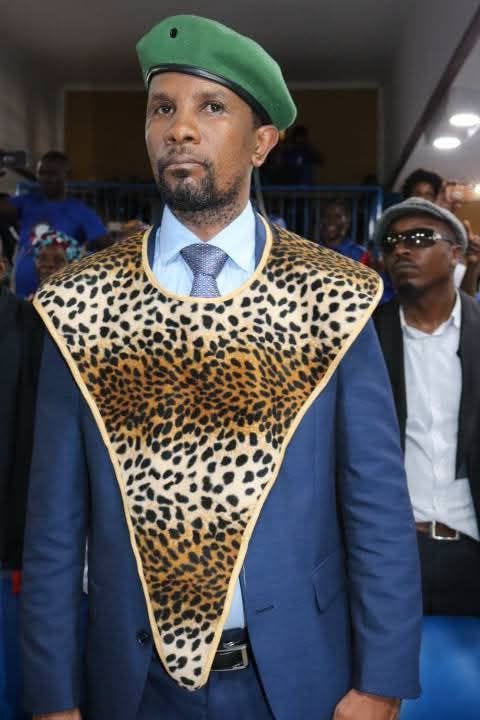
BULAWAYO - The opposition Mthwakazi Republic Party (MRP) has accused Zulu King Misuzulu kaZwelithini of “legitimizing a regime with a legacy of genocide” after the monarch met Zimbabwean President Emmerson Mnangagwa to discuss migration and xenophobia.
In a diplomatic letter dated Tuesday 14 July 2026, MRP president Mqondisi Moyo said the party conveyed “profound concern, deep sadness, and disappointment” over the king’s recent engagements in Zimbabwe.
The letter was copied to South Africa Kings Council chair King Ndamase Ndamase and addressed to the king’s spokesperson, Mpikayise Buthelezi.
“We acknowledge that Your Majesty’s discussions reportedly focused on xenophobia, Afrophobia, regional migration, and the welfare of Zimbabwean nationals residing in the Republic of South Africa,” Moyo wrote. “However, lasting solutions cannot be achieved by addressing the outward symptoms of migration while remaining silent on the brutal governance conditions, structural atrocities, and political hostility that compel citizens to leave their homeland.”
Moyo told the king that “migration is fundamentally a governance and human rights issue before it becomes an immigration issue,” arguing that citizens “flee when their security, identity, and lives are systematically threatened.”
The MRP letter links current migration flows to historical grievances in Matabeleland. It cites what it calls the “1979 Shona Grand Plan,” which it claims detailed the “political, economic, and cultural marginalization of the Ndebele people” in post-independence Zimbabwe.
It further alleges that the ZANU government under Robert Mugabe and Mnangagwa “unleashed the Gukurahundi genocide in the 1980s,” using the North Korean-trained Fifth Brigade to “systematically massacre over 100,000 innocent Ndebele civilians.”
“The very man Your Majesty visited, Emmerson Mnangagwa, was the Minister of State Security at the time, directly overseeing and orchestrating this genocide,” Moyo wrote.
He said the MRP had attached copies of the “1979 Shona Grandplan and the evidential documents on the Gukurahundi Genocide” for the king’s attention.
Moyo added that “this historical persecution has mutated into a modern ‘South Africa Grand Plan,’ wherein the ZANU-PF regime deliberately impoverishes Matabeleland, destroying its economy and forcing our youth to flee en masse into South Africa as undocumented migrants.”
The letter invokes the SADC Treaty and African Charter on Human and Peoples’ Rights, saying member states must uphold “democracy, human rights, the rule of law, peace, security, and regional cooperation.”
It flags “ongoing constitutional developments in Zimbabwe, including the public debate surrounding Constitutional Amendment Bill No. 3 (CAB3),” warning that “where constitutional confidence weakens and tyrannical laws are consolidated, uncertainty increases, investment declines, and outward migration intensifies.”
Moyo drew parallels between the Zulu Kingdom and Mthwakazi, describing Matabeleland as “a historical state whose sovereignty was violently disrupted, yet its people remain distinct from the dominant political identity imposed by Harare.”
“By traveling to Harare to meet with him to discuss ‘foreigners’ and ‘deportations’ in South Africa, Your Majesty inadvertently legitimizes a regime that has spent decades stripping the Mthwakazi people of their citizenship, dignity, and safety,” Moyo wrote. “There is no justifiable reason for the Zulu King to glorify a leader whose hands are stained with the blood of our people.”
The MRP urged the king and accompanying traditional leaders to “look closely at the open wounds of the Mthwakazi nation, and to protect the sacred integrity of the Zulu Crown from being used as a diplomatic shield for a regime carrying a legacy of genocide.”
“Authentic Pan-African solidarity is best advanced when African leaders, both traditional and political, collectively encourage constitutional governance, institutional integrity, and respect for fundamental rights by holding oppressive leadership accountable,” Moyo said.
The letter closed with “assurances of our highest consideration and our continued respect for the esteemed institution over which Your Majesty presides.”
At the time of publication, the Office of His Majesty The King had not issued a public response to the MRP letter.
King Misuzulu’s recent visit to Zimbabwe included discussions on migration and the welfare of Zimbabwean nationals in South Africa, amid ongoing tensions over undocumented migrants and sporadic xenophobic violence.
The MRP, which advocates for the restoration of Mthwakazi statehood, has repeatedly accused Harare of marginalizing Matabeleland and failing to address Gukurahundi.
The Zimbabwean government has previously described Gukurahundi as a “moment of madness” but disputes genocide claims and casualty figures cited by critics.