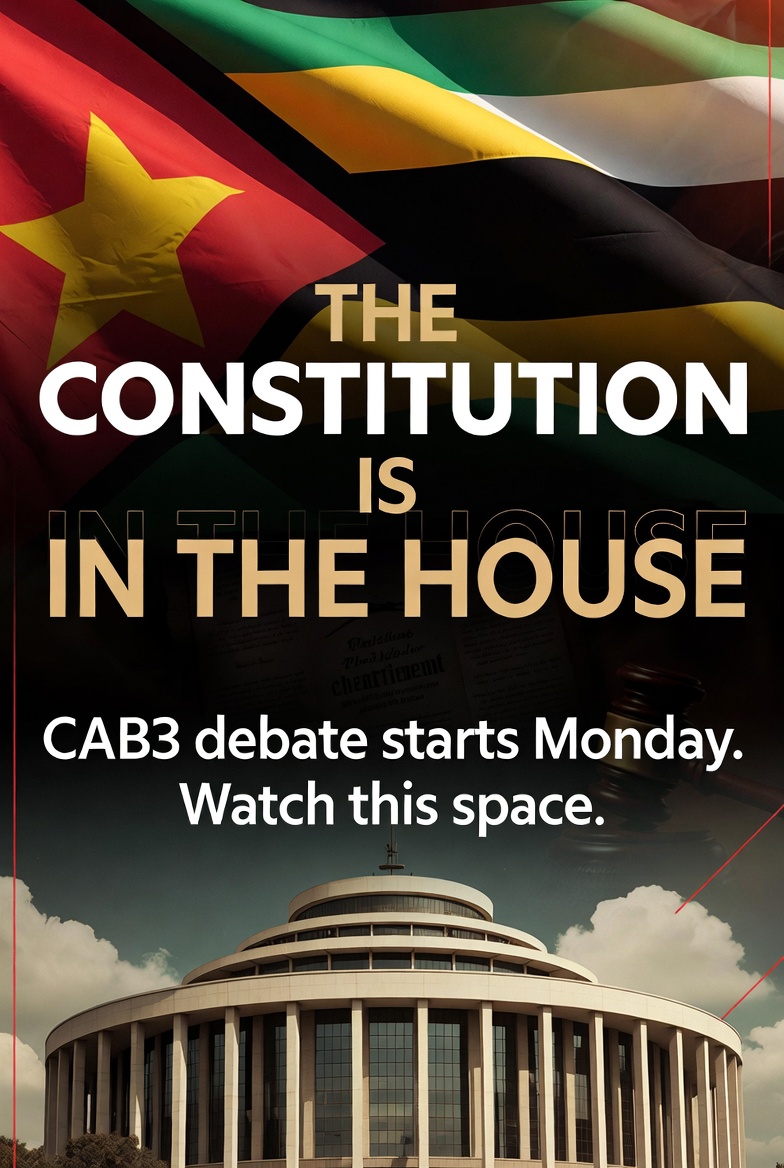
HARARE – Constitutional Amendment Bill No. 3 (CAB3) heads to Parliament this week for debate, setting up a high-stakes clash between ZANU-PF’s supermajority and a flurry of court challenges that could derail the controversial legislation.
Parliament resumes sittings today Monday, June 1, after a break to process public submissions.
Justice Minister Ziyambi Ziyambi is expected to move the Second Reading of CAB3 in the National Assembly, marking the first major test for the Bill that seeks to overhaul Zimbabwe’s 2013 Constitution.
Gazetted on February 16, 2026, CAB3 proposes sweeping reforms, including extending terms for the President, Parliament and local authorities from five to seven years.
The bill also seeks to scrap direct election of the President, replacing it with election by a joint sitting of Parliament and expanding the Senate and allowing the President to appoint 10 additional senators for “professional skills.” The bill seeks to abolish the Zimbabwe Gender Commission and National Peace and Reconciliation Commission, amongst a raft of other changes.
Today, Justice Portfolio Committee, chaired by MP Eddison Zvobgo Jr, will hold a final meeting to consolidate submissions from the 90-day consultation period that ended May 18.
At the same time, lawyers for war veterans represented by Professor Lovemore Madhuku are expected to file an urgent Constitutional Court application seeking to interdict the Bill’s Third Reading.
Activists Allan Chipoyi and former MP Amos Chibaya are also refiling a High Court challenge after withdrawing their first case last month.
If CAB3 clears Second Reading, it will move to Committee Stage for clause-by-clause debate.
ZANU-PF’s two-thirds majority makes passage likely.
The earliest Third Reading could occur by the end of the week.
The Constitutional Court may hear arguments for an interdict around June 10-12. If granted, Parliament would be barred from advancing the Bill.
Should the National Assembly pass CAB3, it will be transmitted to the Senate, where ZANU-PF also holds a two-thirds majority. Senate approval could take as little as 48 hours.
If both Houses approve, CAB3 will be sent to President Mnangagwa for assent. He has 21 days to sign it into law. Legal experts say court challenges could still strike down the Act after assent.
The biggest threat to CAB3 is section 328(7) of the Constitution, which bars an incumbent from benefiting from a term-limit amendment unless a referendum is held.
Government argues CAB3 extends “electoral cycles,” not “term limits,” and therefore does not require a referendum.
Opponents, including former legislator Prince Dubeko Sibanda, contend that moving from five to seven years is a de facto term extension that must be put to the people.
In Parliament, ZANU-PF commands more than the 187 votes needed in the 280-seat National Assembly. Senate passage is equally assured. The opposition CCC’s position remains fractured.
Leader of the Opposition Sengezo Tshabangu has not stated whether his MPs will vote against CAB3, abstain, or support it.
Outside Parliament, the Bill faces at least three separate legal challenges questioning both procedure and substance.
Public hearings were marred by reports of violence and intimidation, which lawyers say could invalidate the process.
If no court grants an interdict, CAB3 could be law by the end of June.
If the Constitutional Court rules that a referendum is required, the Bill would collapse unless government calls a national vote - a politically risky move.
Clerk of Parliament Kennedy Chokuda last week said he was “satisfied with the progress” of consultations, which drew over 300,000 submissions.
The coming month will test whether ZANU-PF’s parliamentary dominance can overcome the legal and constitutional hurdles now converging on CAB3.